Metronome for music practice

A steady, sample-accurate click for practising any instrument, with time signatures, accents, swing and a range of click sounds.

Download on the App StoreComing soon on theقريباً علىApp Store

One-time purchase. No subscription, no ads, no accounts.

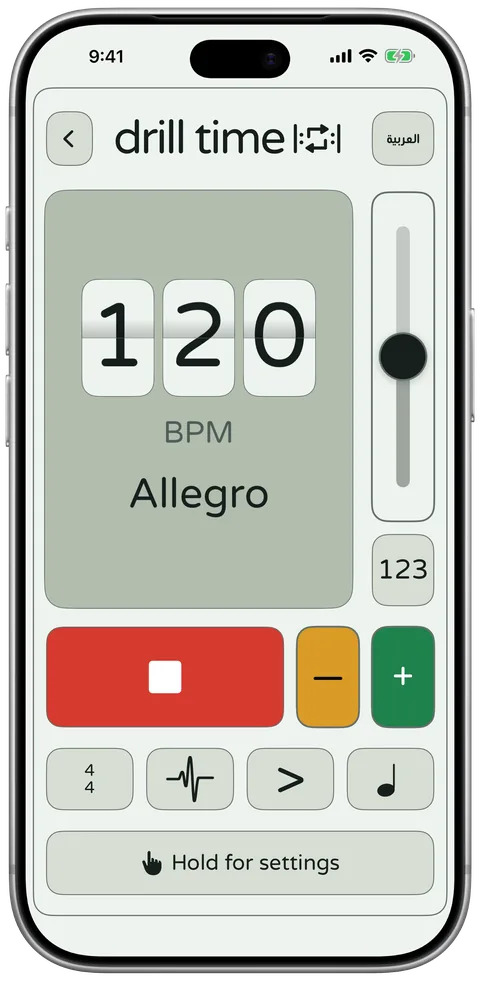
DrillTime metronome screen at 120 BPM with the tempo name Allegro, a tempo slider, and start, minus and plus buttons

Set the tempo your way

Drag the slider, tap plus or minus, type it on the keypad, or tap the tempo display in time to set it. Choose anything from 20 to 220 BPM, or up to 250 if you widen the range in Settings.

Under the BPM you see the tempo marking:

Tempo markings

  • Grave
  • Largo
  • Adagio
  • Andante
  • Moderato
  • Allegro
  • Presto
  • Prestissimo
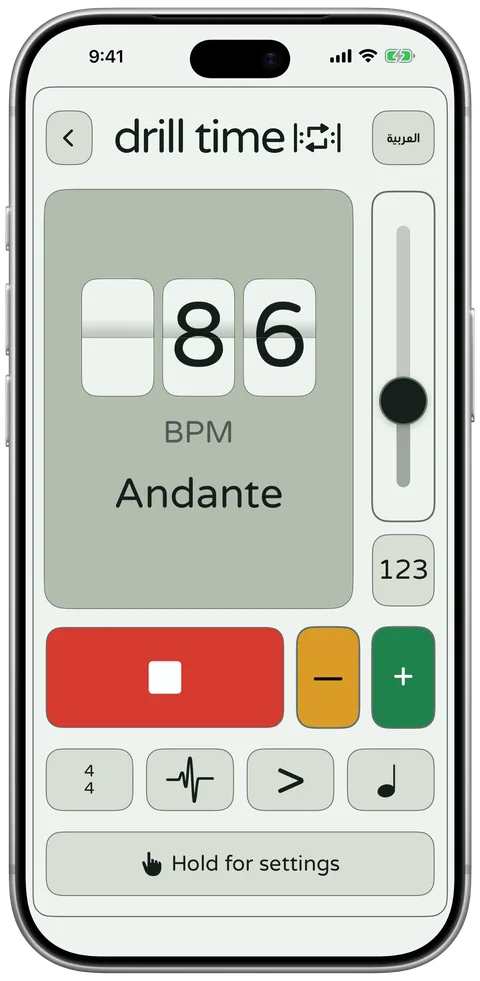
DrillTime metronome screen showing 86 BPM with the tempo name Andante, plus and minus buttons and a tempo slider

17 time signatures, clearly grouped

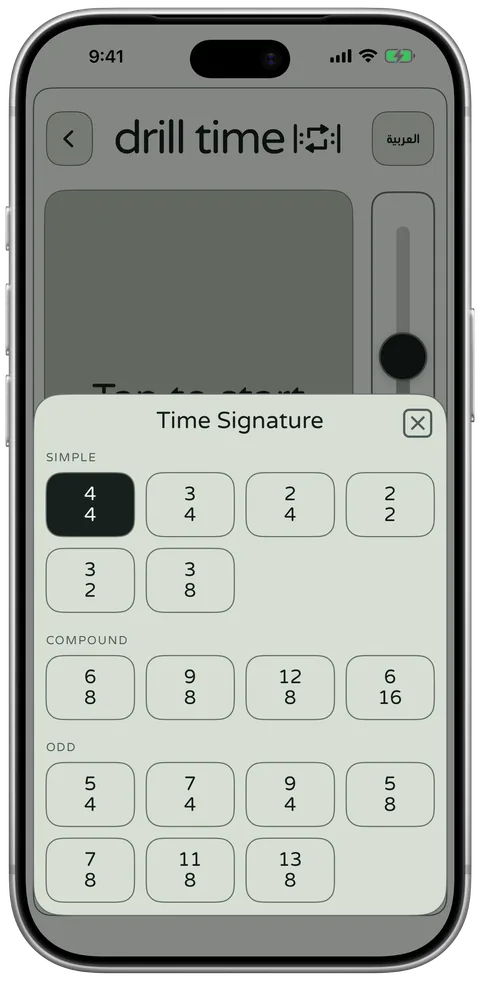
Simple, compound and odd time signatures each have their own group. Tap the beats you want accented, and odd metres are grouped for you, such as 7/8 as 2+2+3.

Simple

  • 4/4
  • 3/4
  • 2/4
  • 2/2
  • 3/2
  • 3/8

Compound

  • 6/8
  • 9/8
  • 12/8
  • 6/16

Odd

  • 5/4
  • 7/4
  • 9/4
  • 5/8
  • 7/8
  • 11/8
  • 13/8
The Time Signature sheet in DrillTime, with simple, compound and odd time signatures to choose from

Divisions, swing and six click sounds

Hear each beat as crotchets, quavers, semiquavers or triplets, or as dotted crotchets and duplets in compound time. Add swing in simple time, and pick the click that cuts through best over your instrument.

Clicks in one bar of 4/4
Crotchets, 1 per beat
Quavers, 2 per beat
Triplets, 3 per beat
Semiquavers, 4 per beat

Click sound

  • Clave
  • 78
  • 808
  • 909
  • Shaker
  • Beep

Practising with the metronome

How to use it, the habits I teach, key terms and common questions.

Who it helps

In my lessons, most timing problems come back to one thing: the pulse drifts and the student does not notice. A metronome makes that drift easy to hear. It helps:

  • Beginners who rush the easy bars and slow down in the hard ones.
  • Students preparing a piece for a lesson, a concert or an exam.
  • Teachers who want every student to practise at a set tempo between lessons.
  • Bilingual classrooms, because every screen works in English and Arabic.

How to use it

Choose a tempo and a time signature, then start the click and practise along with it. Begin slowly, and only raise the tempo when the passage feels easy.

  1. Set the tempo with the slider or the plus and minus buttons. The screen shows the BPM and its Italian tempo name, such as Andante or Allegro.
  2. Pick the time signature, and use accents to mark the strong beats of the bar.
  3. Add swing if the style needs it, and choose the click sound you hear best over your instrument.
  4. Hold the settings button for a light or dark theme, sound or flash output, a count-in, and your default tempo and click sound.

Practice tips from a teacher

Musicians have long practised with a metronome to keep a steady tempo (opens in a new tab), the speed of the music. These are the habits I teach with it:

  • Start slower than you think. If you cannot get a passage right three times in a row, the tempo is too high.
  • Listen for the click disappearing. When you are exactly together with it, the click almost vanishes under your note.
  • Count out loud for the first few bars, especially after a rest.
  • Keep sessions short and focused. Ten good minutes beat an hour of drifting.
  • Turn the click off for the last run-through and check that the tempo holds on its own.

A simple daily routine

A 20-minute metronome practice routine

  1. Warm-up3 minutes

    Long notes or open strings with the click at a slow, comfortable tempo

  2. Technique5 minutes

    Scales or exercises, two notes per click, then four

  3. Piece, slowly7 minutes

    The hardest bars of your piece at a tempo you can perform cleanly

  4. Piece, faster3 minutes

    Raise the tempo a little and repeat the whole section

  5. Without the click2 minutes

    One run-through on your own to check the pulse holds

Key terms

Metronome
A device or app that sounds a steady click at a tempo you choose, so you can keep an even pulse.
BPM
Beats per minute. At 60 BPM there is one beat every second; at 120 BPM there are two.
Tempo
The speed of the music, given in BPM or with an Italian word such as Andante (at a walking pace) or Allegro (cheerful and fairly fast).
Subdivision
Splitting each beat into smaller equal parts, such as two quavers or four semiquavers, to keep faster notes even.

Questions

Can I use the DrillTime metronome with any instrument?

Yes. It is a steady click, so it works for guitar, piano, strings, wind, drums or voice. Choose the click sound that cuts through best over your instrument.

Does the metronome work without an internet connection?

Yes. DrillTime works fully offline and needs no account, so it is ready in a practice room, a classroom or on a shared iPad.

What tempo should I start at?

Start at a tempo where you can perform the passage cleanly three times in a row. For many students that is well below the marked tempo, and that is fine.

Practise with DrillTime

Download on the App StoreComing soon on theقريباً علىApp Store

One-time purchase. No subscription, no ads, no accounts.